
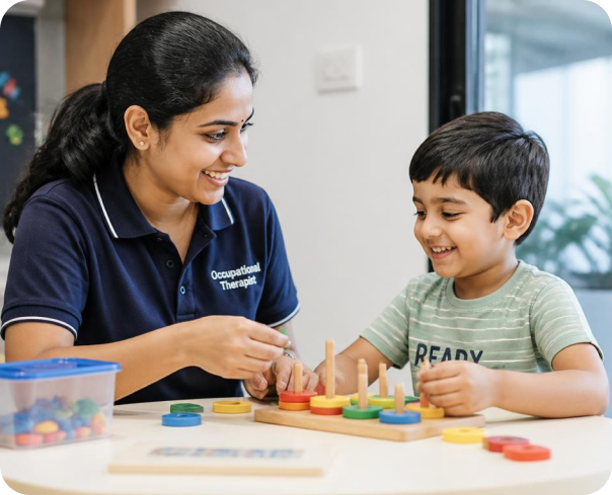
An Occupational Therapy Assessment is a structured evaluation of how a child manages everyday activities at home, school, and during play. It helps identify difficulties with movement, coordination, sensory processing, attention, handwriting, self-care, and other functional skills.
During a developmental OT assessment, the therapist considers the child’s developmental history, current abilities, challenges, and daily routines. The assessment combines parent discussion, clinical observation, and age-appropriate activities to understand how the child performs different tasks and where additional support may be needed.
The findings help identify the child’s strengths and areas of difficulty. Parents receive clear recommendations based on the assessment, which may include occupational therapy, home activities, school support, or further evaluation where appropriate.
We assess how your child uses their hands and body during everyday activities. This includes balance, coordination, strength, motor planning, pencil control, grasp, drawing, cutting, throwing, and catching. These observations help identify movement difficulties that may affect play, schoolwork, and age-appropriate daily activities.
We observe how your child responds to sensory input such as touch, movement, sounds, visual information, and body position. The assessment considers whether sensory responses affect attention, behaviour, play, learning, transitions, or participation in everyday routines at home and school.
We assess how your child understands and uses visual information during everyday tasks. This may include recognising shapes, copying patterns, completing puzzles, finding objects, understanding positions, drawing, reading, and writing. These skills are important for classroom activities, coordination, navigation, and independent participation.
We evaluate how independently your child manages everyday activities such as dressing, eating, grooming, toileting, using utensils, organising belongings, and following routines. The assessment considers the level of assistance, prompting, or supervision required and identifies practical areas where greater independence can be developed.
An OT evaluation for kids with developmental concerns looks at functional skills, sensory responses, motor abilities, play, attention, and independence. It helps identify areas affecting everyday participation and where occupational therapy support may be useful.
This evaluation looks at how a child responds to different types of sensory input and whether these responses affect participation in everyday activities. The findings can help guide appropriate therapy strategies and practical support at home and school.
When appropriate, standardized tools such as DASH and Movement ABC can be used to assess handwriting, coordination, balance, and motor performance. These tools provide structured information about specific areas of difficulty and help guide therapy goals.
Children who have difficulty planning, sequencing, or coordinating movements may benefit from a focused assessment. The therapist observes how the child approaches movement tasks and identifies areas affecting functional participation, including play, school activities, and everyday routines.
The therapist assesses the child's ability to complete age-appropriate daily activities such as dressing, feeding, grooming, toileting, and managing school routines. The evaluation helps identify practical areas where greater independence can be developed with appropriate strategies and support.
When needed, the therapist reviews the child's home environment, positioning, equipment, and everyday routines. Recommendations may include changes to the environment or use of suitable equipment to support safety, accessibility, comfort, and greater independence during daily activities.
The assessment begins with a discussion with the parents or caregivers. The therapist asks about the child's developmental history, current concerns, daily routines, school participation, and activities that may be difficult.
Parents can also share previous reports, school observations, or specific concerns they have noticed at home.
The child participates in age-appropriate activities while the therapist observes movement, coordination, sensory responses, visual skills, attention, play, and functional abilities.
Activities are adapted to the child's age and comfort level. The aim is to understand how the child approaches different tasks rather than simply whether they can complete them.
The therapist reviews information from the family discussion, clinical observations, and any standardized tools used during the assessment. The report outlines the child's strengths, areas of difficulty, functional abilities, and identified support needs.
The findings provide a clear reference for planning appropriate next steps.
The therapist discusses the findings with the parents and explains what they mean for the child's everyday activities. If occupational therapy is recommended, goals are developed according to the child's individual needs.
The plan may focus on areas such as motor skills, sensory processing, handwriting, coordination, self-care, or participation in school and home routines.

Explain that the therapist will meet them and do simple activities or games to understand how they move, play, and manage everyday tasks. Avoid putting pressure on your child to perform in a particular way.
Parents can bring previous assessment reports, therapy records, school feedback, or other relevant information that may help the therapist understand the child’s needs.
An occupational therapy assessment is used to understand a child’s current abilities, challenges, and functional needs. It provides a starting point for identifying appropriate goals and recommendations.
Ongoing therapy is the intervention that follows when specific areas have been identified for support. Therapy focuses on working toward those goals through structured activities and regular progress reviews.
An assessment does not automatically mean that a child requires ongoing therapy. Recommendations depend on the child’s individual findings and needs.