
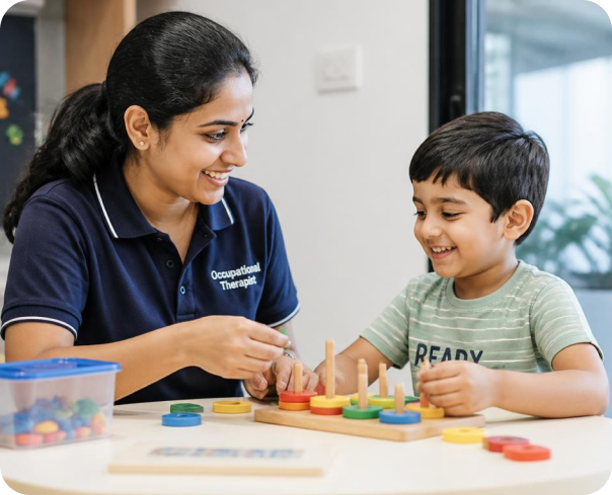
Autism Spectrum Disorder is a developmental condition that shapes how a child communicates, interacts, and experiences the world around them.
It’s called a “spectrum” because no two children with autism are alike. Some children find speech and social interaction most challenging, while others communicate well but struggle with sensory input, routines, or unstructured social situations. There’s no single “type” of autism, which is why two children with the same diagnosis can look very different from one another.
Signs most often appear between 18 months and 3 years, usually noticed first by parents or preschool teachers. Early identification matters, as the brain is most adaptable in these early years, and timely support can shape how a child learns to communicate, regulate emotions, and build relationships.
At Six Senses, therapy is built around your child’s individual profile, not a one-size-fits-all program.
The child may not turn toward their name being called, even after repeated attempts, and may avoid or briefly break eye contact during interactions with familiar and unfamiliar people alike.
First words often arrive later than typical developmental milestones, and gestures like pointing, waving, or nodding may be limited, inconsistent, or absent entirely.
The child may struggle to initiate a conversation, take turns speaking, or stay on a shared topic, often steering talk back toward a preferred subject.
Group play, sharing toys, or understanding the unwritten rules of social games can feel confusing, leading the child to play alongside rather than with peers.
These self-soothing or self-stimulating movements often appear during moments of excitement, stress, or sensory overload, and can become more frequent under pressure.
The child may repeat words, phrases, or entire lines from shows or conversations, either immediately after hearing them or minutes to hours later.
A change in schedule, seating, route, or even the order of daily activities can trigger noticeable anxiety, resistance, or meltdowns.
A deep, narrow interest in a specific topic, object, or activity that can dominate the child's attention and conversation for extended periods.
Everyday sensory input, like clothing tags, fluorescent lighting, or background noise, may feel unbearable to some children and barely noticeable to others.

Difficulty expressing hunger, discomfort, or excitement can leave a child unable to convey basic needs, which sometimes shows up as frustration, tantrums, or withdrawal instead of words.
Birthday parties, classrooms, and family gatherings can feel overwhelming when a child must read social cues, manage sensory input, and follow group dynamics all at once.
Moving from playtime to homework, or from home to school, is often one of the hardest parts of the day, sometimes triggering visible distress well before the transition even happens.
A last-minute change in plans, seating, or schedule can disrupt a child's sense of predictability, leading to anxiety, resistance, or a full meltdown even over something small.
We begin with a thorough evaluation covering your child's communication style, sensory profile, and behavioral patterns. This gives us a clear picture of their strengths and the areas that need focused support, so the plan is built around your child rather than a generic checklist.
Based on the assessment, we design a program that may combine speech and language therapy, occupational therapy, behavior therapy, and social skills training, depending on which areas need the most support.
Parents work closely with our therapists throughout, receiving practical strategies that carry therapy into daily routines at home rather than staying confined to a clinic session.
Progress is tracked regularly, and the plan is adjusted as your child grows and develops new skills, so support evolves alongside them rather than staying fixed.
The goal isn’t to change who your child is, but to help them communicate more easily, manage sensory challenges, and build the confidence to engage with the world on their own terms.

Book an assessment with certified specialists at Sixsenses and get a clear, personalised plan for your child’s development, therapy, and rehabilitation needs.