
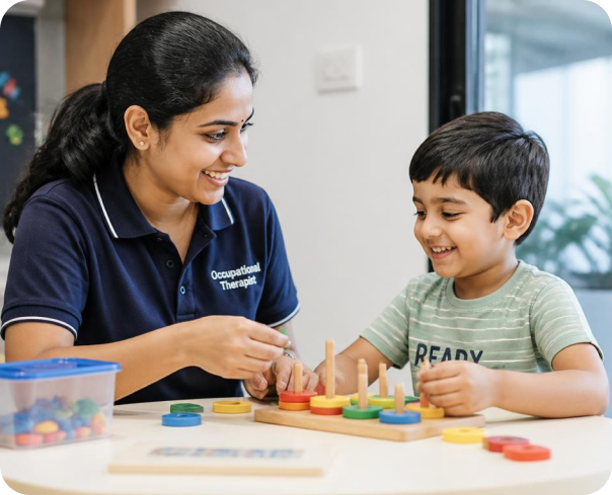
Children develop rapidly during the early years, gaining new skills in communication, movement, learning, play, behaviour, and social interaction. Developmental monitoring and screening help parents understand this progress and recognise areas that may need attention. While every child develops at their own pace, developmental milestones provide useful age-based expectations for skills that typically emerge during childhood.
Developmental monitoring involves observing these skills over time, while developmental screening provides a more structured look at a child’s current abilities. Together, they can help identify developmental concerns early, understand a child’s strengths and needs, and guide families towards appropriate support or further evaluation when required.
We look at how your child communicates using sounds, gestures, words, and sentences, as well as how well they understand language.
We observe how your child develops physical skills such as sitting, crawling, walking, running, maintaining balance, and using their hands.
We consider how your child explores their surroundings, solves simple problems, remembers information, and learns new skills.
We observe how your child plays, interacts with others, expresses emotions, and responds to people around them.
We look at how your child follows instructions, responds to everyday routines, and engages with people in different situations.
We look at how your child understands and uses sounds, gestures, words, and language to communicate with others.
We observe how your child develops gross and fine motor skills that are appropriate for their age and stage of development.
We consider how your child explores, maintains attention, solves simple problems, and develops early learning skills.
We observe how your child interacts and plays with others, expresses emotions, and responds during social situations.
We look at how your child responds to people, follows instructions, manages routines, and engages in everyday situations.
Children may not always show obvious signs of developmental difficulties. Regular monitoring and screening can help identify concerns earlier, when they may be easier to understand and address.
When a developmental concern is identified, families can explore appropriate support and intervention. Early intervention can help children develop skills needed for participation at home, school, and in the community.
Identifying developmental difficulties early can help families understand the areas where a child may need additional support. Addressing these needs early can make it easier to plan appropriate strategies for learning and participation.
Some developmental concerns may not be immediately noticeable in everyday routines. A structured screening can highlight areas that may need a closer evaluation, even when a child appears to be progressing well in other areas.
Developmental screening is not only about identifying concerns. It also helps parents understand their child's strengths and current abilities. Having clear information can make developmental decisions feel less uncertain.
Development does not stop after one screening. Continuing to observe a child's progress helps families and professionals understand how skills are changing over time and whether recommended support is helping.
The screening findings are explained in simple, easy-to-understand language. We discuss your child’s strengths, areas of concern, and whether any skills may need closer attention.
If further evaluation is recommended, your child participates in age-appropriate activities. The therapist observes communication, movement, play, attention, interaction, and other relevant developmental skills. Activities are adapted to your child’s age and comfort level.
Information from the screening, parent discussion, observations, and any additional assessment is reviewed. The report provides a clearer picture of your child’s developmental abilities, strengths, areas of difficulty, and support needs.
The findings are used to plan the most appropriate next steps for your child. Recommendations may include continued developmental monitoring, home activities, therapy, school support, or further evaluation, depending on individual needs.

Yes. Parents and caregivers can observe communication, movement, play, learning, behaviour, and social interaction during everyday activities. Tracking these changes can help identify concerns and provide useful information to discuss with a developmental professional.
Children develop at different rates, so differences do not always indicate a delay. However, persistent concerns or missed milestones should be discussed with a professional. Early evaluation can provide clarity and help identify appropriate support.