
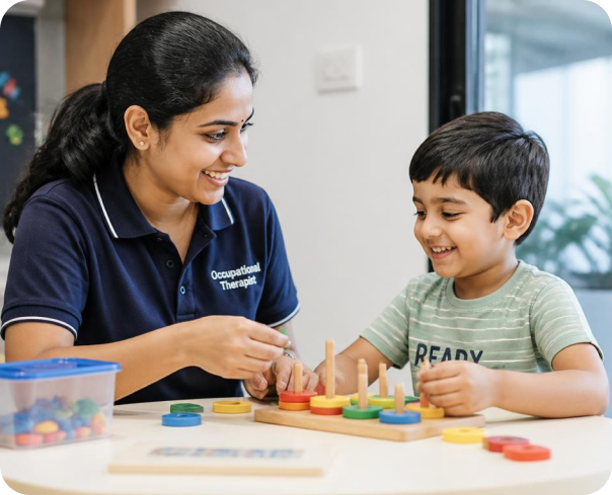
A speech and language assessment looks at how your child communicates today and where they may need support. It covers how clearly they speak, how well they understand what’s said to them, and how they use language with others.
Children develop at different paces, but certain skills are expected within set age ranges. This assessment shows where your child stands against those ranges, using parent conversation, guided play, and structured tasks. Sessions are built around your child’s age and comfort, so it never feels like a test. You’ll leave with a clear read on your child’s communication skills and a plan for next steps, whether that’s therapy, monitoring, or further evaluation.
The therapist observes your child's speech during natural play and conversation, noting how sounds are formed and used in real, everyday interactions rather than in a formal testing setting.
We use structured tasks such as picture naming, describing images, and short conversations, recording sound patterns carefully and comparing them against expectations for your child's age group.
We may also check the movement and coordination of the mouth and facial muscles, since speech clarity depends on more than simply knowing which sound to make.
Language covers both what your child understands (receptive language) and what they can express (expressive language), including vocabulary size, sentence structure, grammar, and the ability to hold a conversation or tell a simple story from start to finish.
We observe vocabulary size and word combinations through play and conversation, and rely heavily on your input for what your child says at home, since young children often talk less around unfamiliar adults or new settings.
We use standardised tasks such as picture description, answering questions, and forming sentences, all recorded and analyzed during the session for accuracy.
Results are compared against typical developmental milestones for your child's age group, so we can flag any gaps early and plan next steps accordingly.
Checks how clearly your child forms individual sounds and words, and whether errors match their age group.
Assesses how well your child follows spoken instructions and understands language used by parents, teachers, and peers.
Evaluates how your child processes, interprets, and responds to sounds and spoken information around them daily.
Examines the strength, movement, and coordination of the lips, tongue, and jaw used for speech.
Assesses pitch, volume, and vocal quality during speech, noting any strain or unusual vocal patterns present.
Looks at vocabulary size, sentence building, and how well your child turns thoughts and ideas into spoken words.
Covers turn-taking, eye contact, and how appropriately your child uses language during conversation and everyday play.
Reviews the rhythm and flow of speech, including repetitions, blocks, or prolonged sounds during everyday talking.
Checks how your child chews, swallows, and manages food and liquids safely during everyday family meals.
Looks at attention, memory, and problem-solving skills that support your child's overall ability to communicate effectively.
We start by talking with you about your concerns, your child's developmental history, and what you've noticed at home in their everyday speech and behavior. This conversation shapes how we approach the rest of the assessment.
Your child works one-on-one with our speech-language pathologist through play-based activities, picture tasks, and age-appropriate exercises, so the assessment feels natural and engaging rather than clinical, even for children who are shy or easily distracted.
We put together a written report covering what we observed during the session, where your child stands against expected developmental milestones for their age, and any specific areas of concern that came up.
We walk you through the findings in plain, jargon-free language and answer your questions directly. If therapy is recommended, we outline a plan built around your child's specific needs, goals, and pace of progress.

Expect a mix of conversation with you, observation of your child at play, and some structured tasks depending on their age. Sessions are kept relaxed, and you’re welcome to stay involved throughout.
Bring any prior reports from doctors, teachers, or therapists, a list of words or milestones your child has reached, and notes on specific concerns you want addressed. A comfort item for your child can also help.