
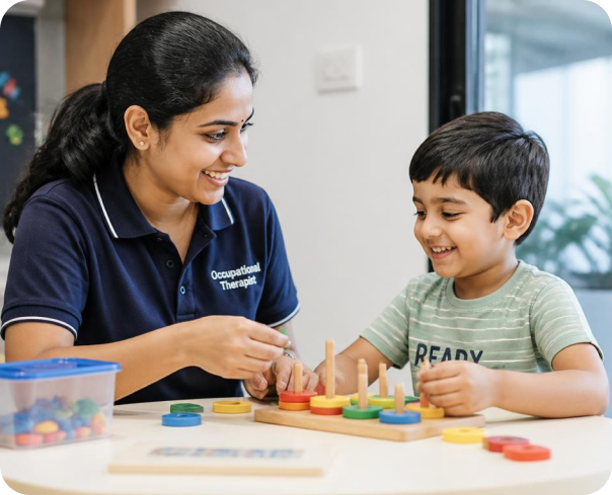
Global Developmental Delay (GDD) refers to a significant delay in two or more areas of a child’s development, typically diagnosed in children aged five and under. These include physical and motor skills, cognitive ability, speech and language, and social and emotional development. GDD affects multiple areas of growth at once, making early identification especially important, and affects an estimated 1 to 3 percent of preschool-aged children.
GDD has no single clear cause, often stemming from genetic, neurological, and environmental factors, and the exact cause isn’t always identified. This shouldn’t delay seeking support, since early intervention remains the most important factor in a child’s progress.
Developmental Delay usually refers to a child lagging in one specific area, such as speech or motor skills, while otherwise developing typically for their age. It is often temporary, and many children catch up with time, maturity, and targeted support in that one area.
Global Developmental Delay, by contrast, involves delays across two or more developmental domains at once, such as cognitive, physical, and social skills together. Because it spans multiple areas rather than one, GDD tends to require a broader, multidisciplinary approach to therapy rather than a single, targeted intervention, and is generally considered a more complex diagnosis to manage.
Children with GDD may be slow to babble, speak their first words, or build vocabulary, and may struggle to understand or follow simple instructions for their age. This can include both difficulty understanding language and difficulty expressing themselves clearly.
Delays can affect large movements like crawling, walking, and climbing stairs, as well as smaller motor tasks like holding a pencil, using scissors, or buttoning clothes. Some children may also appear clumsy or have low muscle tone.
Difficulty with problem-solving, memory, following directions, or grasping concepts appropriate for their age can signal a cognitive component to GDD, often becoming more apparent once a child starts school.
Children may struggle to engage with others, form relationships, respond to emotional cues, make eye contact, or manage frustration and change, sometimes leading to prolonged tantrums that take longer than expected to settle.
Basic self-care tasks such as feeding, dressing, or toileting may take considerably longer to develop compared to same-age peers, affecting a child's growing sense of independence.

At Sixsenses, we take a coordinated, multidisciplinary approach to GDD, since delays rarely occur in isolation and progress in one area often supports progress in another.
We evaluate your child across all developmental domains, including speech, motor skills, cognition, and social-emotional functioning, to build a clear, individual profile before recommending a path forward.
Every plan at Sixsenses is built around your child's specific pattern of delays, since GDD looks different in every child and rarely responds to a single, uniform approach applied across all cases.
For children with communication delays, we work on vocabulary, comprehension, and expressive language through structured, engaging sessions tailored to their current level.
We target both fine and gross motor skills, helping children build the coordination, strength, and confidence needed for everyday tasks and physical milestones.
Therapy helps children build problem-solving skills, attention, and adaptive behaviours needed for learning and daily functioning, both at home and in structured settings.
Parents receive practical guidance on reinforcing therapy goals at home, celebrating small milestones, and supporting their child's progress consistently between sessions.
We track development across sessions and adjust the plan as your child grows, since needs and priorities often shift meaningfully over time.

Book an assessment with certified specialists at Sixsenses and get a clear, personalised plan for your child’s development, therapy, and rehabilitation needs.